
Barcelona, like most big cities, comes alive with its vibrant, buzzing streets. However, these spaces are mostly occupied by cars and other motorized vehicles, more than people. In Barcelona, too, cars take up 60% of public space in the streets. In an attempt to reduce traffic and create people-first spaces, Barcelona introduced an ambitious plan. It is an urban model called Superblocks, where spaces are reclaimed to fill the city with life, as they say.
Barcelona’s Superblocks: A Revolutionary Plan
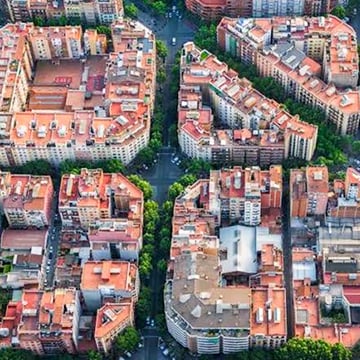
Superblocks or Superilles are mini-neighborhoods made up by unifying nine existing blocks (3x3). They are not created by filling the gaps with buildings, but rather by transforming the public spaces and their use. It is based on the idea of putting citizens and bicycles ahead of vehicles. In Barcelona’s superblock model the goals were to reduce traffic, noise, and pollution while also addressing community issues and sustainability.
The model works as a square with nine blocks, where the outer line is used as basic roads for traffic, while the inner roads follow the 10 km/h limit and are used for people and bicycles. Between the blocks, greenery and public spaces are added in the form of plazas, playgrounds, or seating.
Barcelona’s Urban Planning Legacy
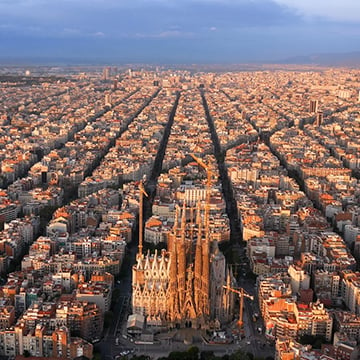 Barcelona has always stood out for its intentional approach to city planning, even getting recognized as UNESCO World Capital of Architecture. This legacy dates back to Ildefons Cerdà's plan that reshaped the city in the mid-19th century. So while the superblock strategy can be applied to any city, its foundation is rooted in the grid layout and wide streets of the Eixample district.
The Cerdà Plan was built on the principle of equal access to sunlight and fresh air, to let the city breathe. But time passed, and those streets were filled with cars, yet the same grid eventually made it possible to carve out car-free zones within it. Salvador Rueda's superblock model builds on that design’s principles as a way to reclaim the public space from vehicles. Within the zones, people are the center of the plan, while the flow and functions are diversified, improving and even revitalizing urban areas.
Beyond rebalancing space between vehicles and pedestrians, superblocks in Barcelona expanded to include Green Axes. By bringing vegetation and greenery, the model could be applied more flexibly across the city. Green Axes introduced a new middle ground outside of the rigid two categories, while still meaningfully reducing car dominance. This lets each street keep its own character, while still supporting sustainable mobility and creating soft edges where people can gather.
Where and How Many: Superblocks Across Barcelona
As of 2026, Barcelona has multiple superilles completed and ongoing, with 21 additional green axes and 21 squares planned by 2030. The long-term vision is to establish 503 superblocks city-wide.
In May 2016, the Barcelona city council approved the Omplim de vida els carrers (Let’s fill the streets with life) to move forward with the program. Barcelona’s superblocks plan began in the Poblenou district, with initial opposition in 2017. Many residents and businesses have feared negative impacts on local trade and vehicle circulation. However, later local shop numbers rose by 30%, and residents perceived positive effects of the urban model. As it was the first pilot, the city later refined the plan based on the lessons learned. Thus, the second try at Sant Antoni Superblock was more successful, creating a more fluid flow with an emphasis on quality public spaces. As a key step, citizens' participation was given more weight.
Today, Barcelona’s superblock locations include Poblenou, Sant Antoni, Horta, and Hostafrancs. Explore more about the city and its evolving neighborhoods on our complete guide to everything about Barcelona.
Impacts and Benefits of Barcelona Superblocks: Improving Urban Health by Design
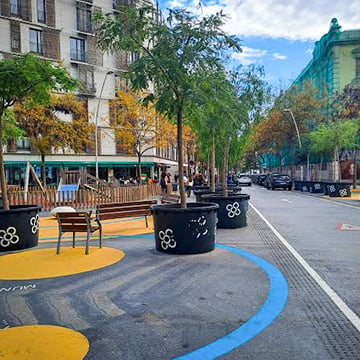 The Superblocks program is a step towards creating a healthy city by reducing traffic in Barcelona’s neighborhoods and establishing calm zones. But are Barcelona's superblocks successful? There are many perceived and recorded improvements, as well as valid concerns.
Improvements in environmental conditions include less vehicle traffic noise and air pollution, as well as more green spaces and social infrastructure. These improvements influence both individual health and environmental sustainability, which, at a larger scale, contribute to fighting the climate crisis.
Pedestrian-priority spaces are another example of how superblocks improve urban health. With public spaces re-conquered, walking, cycling, and outdoor activities have risen among residents. Families with children use these areas to play, office workers for lunch breaks, and elderly residents and teenagers use them to socialize and relax. Many residents also shared how these spaces fostered social interactions within the community.
Of course, Barcelona’s superilles model is not without its challenges. Vehicle traffic redistribution to surrounding areas, gentrification concerns, business logistics, and environmental equity, which is about ensuring that the benefits reach varying groups of residents, all showcase the complexity of the transformation. All in all, the model is continuously evolving and adapting. The City Council has also expanded citizen consultation and participation efforts for better Superblock implementation.
Barcelona as A Global Blueprint for Sustainable Urban Living
 This sustainable urban design has gained worldwide influence. Cities inspired by Barcelona’s superblocks have begun to explore similar projects and implement elements, including Los Angeles, Vienna, Berlin, Bogotá, and Rotterdam.
The initial modelling exercises and the evolution of Barcelona’s superilles showcase how the model can be adapted, and how cities can innovate to face today's challenges. It is an inspiring example because, beyond environmental gains, it puts people at the center of city life. Integrating green spaces and creating walkable neighborhoods in Barcelona not only ensures environmental benefits but also a more livable city, which is one of the main aims of the model.
Its essence lies in giving the streets back to people, as an extension of homes in Barcelona, where public space becomes part of everyday life. The city is a prime example of designing an urban space to actually live in.

 EUR
EUR


