
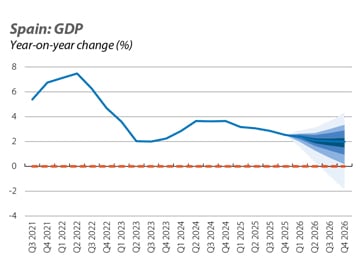
 Spain is entering 2026 with remarkable economic growth! After years, the country is now standing out for its flexibility and structural transformation. Current projections show that Gross Domestic Product / GDP growth in Spain will remain well above the Eurozone average this year. The latest estimates place Spain's economic growth rate between 2.1% and 2.4% for 2026. This pace is nearly double the expected Eurozone average, which is hovering around 1.2%.
Spain’s GDP growth forecasts confirm that domestic demand, migration, and investment are driving expansion rather than short-term stimulus. In other words, we can say that GDP growth in Spain forecasts suggest a balanced contribution from both public and private sectors.
So, if we look at Spain’s economic growth chart closer, we can see that the economy has been steadily improving since the pandemic. After recovering, it has continued to grow at a stable pace. This shows that Spain’s economic outlook is positive, even with uncertainty in the global economy.
Is Spain the Fastest Growing Economy in Europe in 2026?
Yes, indeed it is, or likely to be. When we compare the general growth rate in Spain with neighboring economies, the difference becomes even clear. The data behind Spain’s growth rate vs Eurozone in 2026 highlights a significant performance gap.
Therefore, Spain vs Euro area growth comparison demonstrates that this country is expanding at almost twice the pace of the common currency area. As a result, this country is frequently referred to as the fastest growing economy in Europe, particularly among large EU member states. But why? Why is Spain leading Europe’s growth in 2026? In the next section below, you can find the key drivers and find clear answers about why Spain’s economy is growing each day!
Key Reasons Behind Why Spain Leads the Way on Eurozone Growth
Spain’s strong performance is mainly driven by four key forces: demographic shifts, robust investment inflows, structural changes across major sectors, and supportive financial conditions.
Together, these factors reinforce economic growth and improve overall resilience, and in this section, we will give detailed information about these factors. But before exploring each of them, based on 2026 forecasts we have prepared a table for you to have a clear overview of how they contribute to the country’s performance:
| Indicator | Spain | Eurozone Average |
| GDP Growth | 2.1% - 2.4% | Around 1.2% |
| Inflation | Around 2.0% | Near European Central Bank (ECB) target |
| Labor Force | Growing | Mostly flat |
| Public Investment | Strong, supported by EU funds | Moderate |
| Economic Momentum | Faster than EU average | Slow but steady recovery |
With this overview in mind, let’s now explore the main drivers behind Spain’s growth in detail.
1. Migration and Workforce Dynamics in Spain
Perhaps, migration is one of the most important forces shaping the country’s growth this year. New arrivals bring energy and skills that strengthen industries across the nation. As a result, labor force growth in Spain in 2026 is expanding while giving businesses the workforce they need to meet rising demand.
 Also, the impact of immigration on Spain’s GDP boosts production, consumption, and overall economic activity as workforce expansion in Spain helps companies fill labor shortages. This makes the economy more resilient and competitive.
Beyond labor, migration also supports the demographic growth in Spain’s economy, contributing to a younger and more dynamic population. Over the past few years, the population growth rate of Spain has accelerated thanks to these new residents, while it shows steady momentum that supports housing, services, and infrastructure development.
Further, if we look closely, we can see that there are clear economic reasons people migrated to Spain, including job opportunities, a supportive environment for business creation, and stable institutions. All of these factors also encourage new foreign investments in Spain’s growth, as investors seek reliable and growing markets. Therefore, Spain's economic opportunities in 2026 are rising, particularly in metropolitan and coastal areas where demand for housing and services is strongest.
In conclusion, when we consider all these opportunities such as real estate, labor, and consumption at the same time, it gets easier to see how migration is boosting Spain’s economy and shaping its long-term growth trajectory.
2. High-Value Sectors and Service Dynamics in Spain
Although Spain mostly draws worldwide attention for its tourism sector, it is not relying only on it. Today, Spain’s services sector growth extends to consulting, healthcare, logistics, education, and digital services, reflecting a more diverse and resilient economy that can better adapt to global changes.
 For instance, over the past few years, Spain’s technology sector expansion has strengthened innovation hubs in cities such as Madrid, Barcelona, and Málaga. Today, it supports both startups and established companies in creating new products, services, and solutions. This growth also encourages collaboration between research institutions and businesses, further boosting innovation.
At the same time, Spain’s financial services growth in 2026 reflects the activity in capital markets, increased lending, and growing cross-border investments. These developments make the country a more attractive destination for both domestic and international investors.
On the other hand, strong professional services growth in Spain helps multinational companies in legal, accounting, engineering, and advisory sectors operate efficiently and expand their presence. These services both support businesses and contribute to knowledge transfer and skill development across the workforce.
Overall, these developments are closely tied to the rise of high value-added industries in Spain, which enhance productivity, increase export capacity, and create higher-paying jobs. Together, they reduce dependence on cyclical industries, provide long-term stability, and lay the foundation for sustained economic growth in the country.
3. The Transformative Role of European Funds
The country’s strong performance in 2026 is also closely linked to its effective use of European funding. Today, large-scale NextGenerationEU Spain investments are helping the country modernize infrastructure, digital systems, and green energy projects.
The fact that the distribution of EU recovery funds in Spain focuses on these areas strengthens long-term competitiveness instead of just boosting short-term demand. Observers looking at the EU funding impact on the Spanish economy note improvements in productivity, business confidence, and job creation. So, if you have a question like “How do EU funds impact Spain’s growth?”, the answer is clear: they generate a multiplier effect, as we have stated above in our text.
 These are also a key part of the public investments in Spain in 2026, especially in sustainable development and transport infrastructure. At the same time, stable inflation helps maintain economic predictability. With prices aligning closely with the European Central Bank / ECB inflation target in Spain, households and investors can now plan with confidence, reinforcing Spain’s macroeconomic stability.
Therefore, when the country is compared with other countries in the nearby region, it now stands out in Southern Europe economic performance. Its reform-focused and growth-oriented approach positions the country as a leader in the broader Europe economic recovery in 2026. By combining strategic EU funding with strong domestic investments, the country is creating a resilient and innovation-driven economy that is well-prepared for future challenges.
Future Outlook: Now Is a Strategic Moment to Make a Property Investment in Spain!
To sum up, we can say that Spain is regarded as one of the strongest EU economies in 2026, and this opens a door for investors interested in properties for sale in Spain. As growth remains above the Eurozone average and structural reforms continue, Spain’s real estate market reflects both resilience and opportunity.
If you want to benefit from all of these factors and the price stability in Spain in 2026, we are ready to be beside you through every stage of your investment journey as Spain Homes ® professionals. Our experienced team will guide you with in-depth market knowledge, regional expertise, and a long-term perspective shaped by Spain’s evolving economic landscape.




 EUR
EUR


